
Myopia Management
Slow the progression of your child’s nearsightedness.
Does your child have difficulty seeing distant objects?
Myopia (nearsightedness) typically starts to develop in childhood and often progresses until about age 20.
Slowing the progression is important because it may reduce the risk of developing serious eye conditions later in life such as cataracts, glaucoma, retinal detachment, and blindness.
See how myopia affects your child’s eyes: www.coopervision.com/myopia-simulator
There are several treatment options to slow the progression of myopia. Schedule an exam at Frisco In Focus to learn more.
Myopia is on the rise
Nearsightedness is a growing concern in the US and other countries.
It is estimated that by the year 2050, roughly half of the world’s population will be affected by this eye condition.
Many researchers believe the rise can be attributed to more time spent staring at screens and less time outdoors.
Read When Children Can’t See Far: A Discussion About Pediatric Myopia [PDF]
How do you “manage” myopia?
Determining a myopia control plan for your child starts with a visit to your eye doctor. Schedule your appointment now.
There are a few main approaches to controlling myopia in children, including:
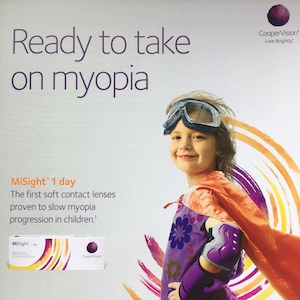 1. Therapeutic Multifocal Contact Lenses
Multifocal contact lenses are special contacts that have different powers in different zones of the lens.
Researchers and eye doctors have found that multifocal soft contact lenses are also effective tools for myopia control in children. Some research demonstrates that using soft multifocal lenses in children caused a 25-50% reduction in progression over 2 years.
Frisco In Focus utilizes MiSight technology.
MiSight’s clever dual-focus design allows children to see clearly while at the same time slowing down eyeball growth and reducing myopia progression. These innovative lenses are a daily disposable design suitable for myopic children as young as eight years old.
Ortho-K – also known as Corneal Refractive Therapy (CRT) or “corneal reshaping lenses” – is a non-surgical approach that helps to reshape the curvature of your child’s cornea using specially designed gas-permeable contact lenses.
Ortho-K contact lenses are only worn during sleep at night and are used to temporarily correct mild to moderate myopia symptoms. Frisco In Focus utilizes the Paragon CRT lens design. You can read FAQs about Paragon CRT lens design here.
Evidence suggests that nearsighted children who undergo several years of orthokeratology may end up with less myopia as adults.
3. Prescription Eye Drops
Learn more here: Five-Year Clinical Trial on Atropine for the Treatment of Myopia
Topical atropine is a medicine used to dilate the pupil and temporarily relax the eye’s focusing mechanism and has been used in myopia control for years.
Several studies show that low-dose atropine helps to reduce the progression of myopia in children, especially when combined with Ortho-K lenses.
Essilor Stellest lenses are glasses designed not only to correct a child’s nearsightedness but also to slow down how quickly it worsens. The lens has a clear central area that provides normal sharp vision, and around it are many tiny invisible lenslets. These lenslets create a special light signal that helps slow the growth of the eye, which is the main cause of increasing myopia. Clinical studies have shown that Stellest lenses can slow myopia progression by about 71% over two years compared with regular single-vision glasses when worn consistently for at least 10 hours per day.
The benefit for your child is clear vision today while helping reduce how quickly their prescription increases over time, which may lower the risk of eye problems associated with high myopia later in life.
Families can visit this website to learn more about this FDA authorized medical device.
If you’d like to learn more about myopia control, request an appointment at Frisco In Focus today.